Conditions
Hibiscus Tea & Blood Pressure: What the Research Really Says
A plain-English look at the studies on hibiscus tea and blood pressure, how to brew it, and who should be careful.

Dondre Burton
Founder, Herbal Harmony TN
Published 7 min read
Reviewed by Herbal Harmony Editorial — Checked for plain language and sourcing. Not a clinical review.
In this article
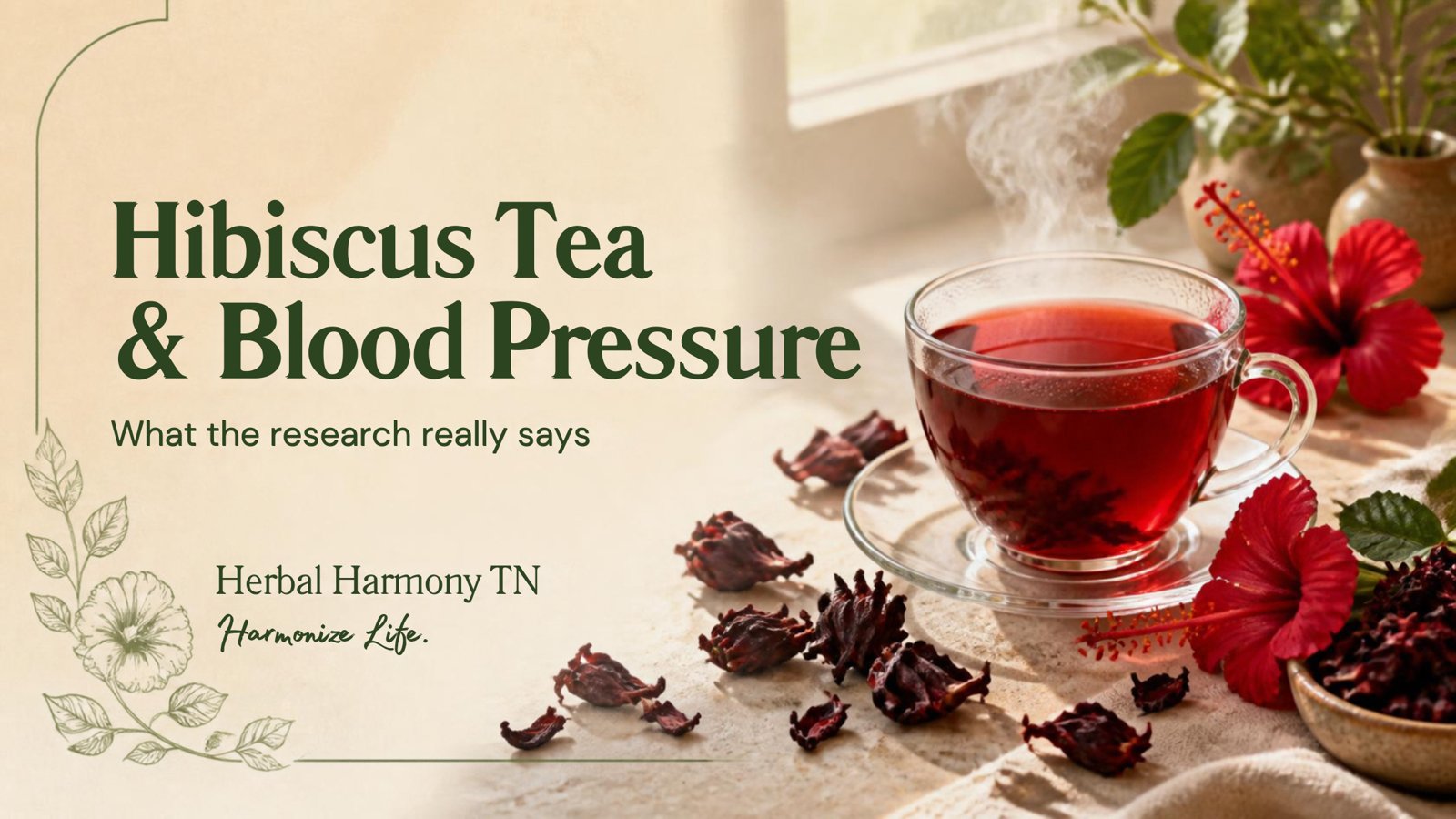
If you grew up around Caribbean, Mexican, or West African kitchens, you probably already know this tea. It's called sorrel, agua de Jamaica, bissap, or karkadé depending on where you are, and it pours out a deep ruby red with a tart, cranberry-like taste.
What fewer people know is that hibiscus is one of the most studied herbal teas when it comes to blood pressure. Researchers have run dozens of trials on it. So let's walk through what they found, in plain language, so you can understand it and pass it along to someone you care about.
First, a quick blood pressure refresher
Blood pressure is written as two numbers, like 130/85, measured in mmHg (millimeters of mercury).
- The top number (systolic) is the pressure when your heart pumps.
- The bottom number (diastolic) is the pressure when your heart rests between beats.
When either number stays high over time, it puts extra strain on the heart, blood vessels, kidneys, and brain. That's why even a drop of a few points matters.
What is hibiscus tea, exactly?
The tea isn't made from the showy flower petals. It comes from the calyces, the deep red, cup-shaped part that holds the flower. The plant's full name is Hibiscus sabdariffa, also called roselle. Those calyces are packed with anthocyanins, the same family of plant pigments that give blueberries and red cabbage their color.
What the studies found
Here's the research, translated out of science-speak.
1. The Tufts University tea study (2010). Researchers gave 65 adults with slightly high or mildly high blood pressure either three cups of real hibiscus tea a day or a look-alike placebo drink, for six weeks. None of them were on blood pressure medication. The hibiscus group's top number dropped about 7 points, compared with about 1 point in the placebo group. People who started with higher readings saw the biggest drops. McKay et al., Journal of Nutrition
2. Hibiscus vs. black tea in people with diabetes (2008). Sixty people with type 2 diabetes and mild high blood pressure drank either hibiscus tea or black tea twice a day for a month. In the hibiscus group, the average top number fell from about 134 to about 113. In the black tea group it actually went up. This was a small study, but it's one of the more striking results. Mozaffari-Khosravi et al., Journal of Human Hypertension
3. Pooling the trials together (2015). When researchers combined the results of several randomized trials (390 people in all), hibiscus lowered the top number by about 7.5 points and the bottom number by about 3.5 points on average. Again, people who started higher tended to see bigger changes. Serban et al., Journal of Hypertension
4. A bigger review (2022). A University of Leeds team looked at 17 trials. Hibiscus lowered the top number by about 7 points compared with placebo. In trials that compared it directly with blood pressure medication, the difference between the two wasn't statistically significant. Ellis et al., Nutrition Reviews
5. The most recent big-picture review (2025). This "review of reviews" gathered 26 randomized trials with nearly 1,800 people. The more hibiscus people took, the more their blood pressure tended to come down. The effect was strongest in adults over 50 and in trials that ran longer than four weeks. It also noted small improvements in cholesterol and blood sugar, and found no increase in side effects. Norouzzadeh et al., Complementary Therapies in Medicine
The pattern across all of this: Hibiscus tends to produce a modest, steady drop, usually showing up after 4 to 6 weeks of drinking it consistently, and it helps most for people whose numbers are already running a little high.
How might it work?
Scientists think hibiscus works in a few gentle ways at once:
- Relaxing blood vessels. It appears to support nitric oxide, which helps blood vessels widen.
- A mild "water pill" effect. Hibiscus is a gentle diuretic, helping the body let go of extra fluid and sodium.
- Calming a key blood pressure enzyme. In lab studies, its anthocyanins slow down ACE, the same enzyme that some common blood pressure medications target.
- Antioxidant protection. Its rich plant compounds help protect the lining of blood vessels. (Hopkins et al., Fitoterapia)
How to brew it
Hot tea: Use 1 to 1½ teaspoons of dried hibiscus per cup of just-boiled water. Steep 6 to 10 minutes, then strain.
Cold brew: Add about 2 tablespoons to a quart of cold water and let it sit in the fridge for 6 to 12 hours. Cold brewing makes it smoother and less sour.
How much did the studies use? Many used around 2 to 3 cups a day for several weeks.
Flavor tips: Hibiscus is tart. A cinnamon stick, a few slices of fresh ginger, or a squeeze of orange all pair beautifully. If you sweeten it, go light, since a lot of added sugar works against your heart health goals.
Who should be careful
Hibiscus is a food that's been enjoyed around the world for generations, but "natural" doesn't mean it's right for everyone.
- If you take blood pressure medication, hibiscus can add to its effect. Talk to your doctor or pharmacist first, and check your pressure at home.
- If you take a diuretic (water pill), like hydrochlorothiazide, the effects may stack.
- If you take diabetes medication, hibiscus may lower blood sugar a bit further.
- If your blood pressure already runs low, skip it.
- If you're pregnant or breastfeeding, avoid hibiscus. There isn't enough safety data.
- Other medications: Hibiscus may affect how the body handles acetaminophen (Tylenol) and the antimalarial drug chloroquine.
Most important: Hibiscus is a supportive habit, not a replacement for prescribed treatment. Never stop or change a medication without talking to your doctor.
The bottom line
The research on hibiscus tea is genuinely encouraging. Across many trials, people who drank it regularly saw their blood pressure come down a few points, especially when their numbers started out a bit high. It's affordable, it tastes good, and it fits easily into a daily routine alongside the basics that matter most: moving your body, cutting back on salt, eating more plants, and getting good sleep.
If this was helpful, share it with someone who's been told to "watch their numbers." Sometimes the best wellness conversations start over a cup of tea.
Harmonize Life.
Quick facts to share
- Hibiscus tea is made from the red calyces of Hibiscus sabdariffa (sorrel, agua de Jamaica).
- In studies, regular drinkers saw their top blood pressure number drop about 7 points on average.
- Results usually showed up after 4–6 weeks of 2–3 cups a day.
- Check with your doctor first if you take blood pressure, diuretic, or diabetes medication. Avoid during pregnancy.
References
Studies retrieved from PubMed.
- McKay DL, Chen CY, Saltzman E, Blumberg JB. Hibiscus sabdariffa L. tea (tisane) lowers blood pressure in prehypertensive and mildly hypertensive adults. J Nutr. 2010;140(2):298-303. doi:10.3945/jn.109.115097
- Mozaffari-Khosravi H, et al. The effects of sour tea (Hibiscus sabdariffa) on hypertension in patients with type II diabetes. J Hum Hypertens. 2009;23(1):48-54. doi:10.1038/jhh.2008.100
- Serban C, Sahebkar A, Ursoniu S, Andrica F, Banach M. Effect of sour tea (Hibiscus sabdariffa L.) on arterial hypertension: a systematic review and meta-analysis of randomized controlled trials. J Hypertens. 2015;33(6):1119-27. doi:10.1097/HJH.0000000000000585
- Ellis LR, et al. A systematic review and meta-analysis of the effects of Hibiscus sabdariffa on blood pressure and cardiometabolic markers. Nutr Rev. 2022;80(6):1723-1737. doi:10.1093/nutrit/nuab104
- Norouzzadeh M, et al. Efficacy and safety of Hibiscus sabdariffa in cardiometabolic health: an overview of reviews and updated dose-response meta-analysis. Complement Ther Med. 2025;89:103135. doi:10.1016/j.ctim.2025.103135
- Hopkins AL, Lamm MG, Funk JL, Ritenbaugh C. Hibiscus sabdariffa L. in the treatment of hypertension and hyperlipidemia: a comprehensive review of animal and human studies. Fitoterapia. 2013;85:84-94. doi:10.1016/j.fitote.2013.01.003
This article is for educational purposes only and is not medical advice. These statements have not been evaluated by the Food and Drug Administration. This information is not intended to diagnose, treat, cure, or prevent any disease. Please talk with your healthcare provider before making changes to your health routine, especially if you take medication.
Sources
Works and references cited in this piece.
- McKay DL, Chen CY, Saltzman E, Blumberg JB. Hibiscus sabdariffa L. tea (tisane) lowers blood pressure in prehypertensive and mildly hypertensive adults. Journal of Nutrition. 2010.
- Mozaffari-Khosravi H, et al. The effects of sour tea (Hibiscus sabdariffa) on hypertension in patients with type II diabetes. Journal of Human Hypertension. 2009.
- Serban C, Sahebkar A, Ursoniu S, Andrica F, Banach M. Effect of sour tea (Hibiscus sabdariffa L.) on arterial hypertension: a systematic review and meta-analysis. Journal of Hypertension. 2015.
- Ellis LR, et al. A systematic review and meta-analysis of the effects of Hibiscus sabdariffa on blood pressure and cardiometabolic markers. Nutrition Reviews. 2022.
- Norouzzadeh M, et al. Efficacy and safety of Hibiscus sabdariffa in cardiometabolic health: an overview of reviews and updated dose-response meta-analysis. Complementary Therapies in Medicine. 2025.
- Hopkins AL, Lamm MG, Funk JL, Ritenbaugh C. Hibiscus sabdariffa L. in the treatment of hypertension and hyperlipidemia: a comprehensive review. Fitoterapia. 2013.
Medical disclaimer
This article is for education only. These statements have not been evaluated by the Food and Drug Administration. It is not intended to diagnose, treat, cure, or prevent any disease, and it is not a substitute for care from a qualified clinician. Talk with your healthcare professional before using herbs, especially if you are pregnant or nursing, have a medical condition, give herbs to a child, or take medication.
About the author
Dondre Burton
Founder, Herbal Harmony TN
Dondre Burton founded Herbal Harmony TN in Memphis. Mullein leaf was his way into herbs, and he writes about teas, plants, and everyday rituals in plain language from his own experience.